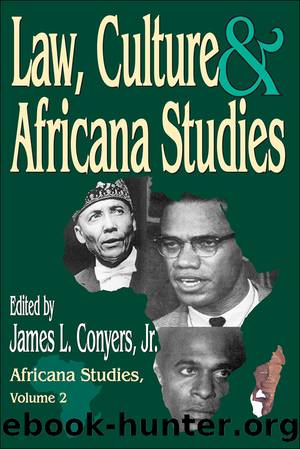
Law, Culture, and Africana Studies by Jr. Conyers
Author:Jr. Conyers [Conyers, Jr.]
Language: eng
Format: epub
ISBN: 9781138526990
Google: E6sotAEACAAJ
Publisher: Taylor & Francis Group
Published: 2017-10-06T04:36:23+00:00
The Culture Nexus and African Literature
African literature continues to manifest a rigorous dialogue about its being, praxis, and analysis. As a subject, scholars have extracted a culture in the sense used throughout this paper and are engaged in a diagnostic exercise. Mudimbe for instance posits, âWhen we speak of African literature we refer to both a body of texts whose authors are known and to anonymous discourses which carry successive deposits of supposedly unknown imaginationsâ (1989, p.7). He also asks, âCould we arrive at any explicative norms which will put it in some sort of relation with other literatures and not give us the uncomfortable feeling that it is somehow an indigenized imitation of something else, or an adapted reproduction of psychological confusions imported from the West?â (p. 7). What Mudimbe clearly demonstrates is the fact that African literature is definitely steps ahead of rhetorical communication in terms of diagnostic exercises and piecemeal interventions. African literature scholars are busy in so many ways asking questions and advancing concepts and theories in trying to diagnose and discover, preferably, systemic interventions clearly with the culture nexus as construct. As with rhetoric, African literature is culture bound, with added complexities of regional, ethnic, linguistic, and colonial legacies at play.
It is interesting to note that Mudimbe also argues that âAfrican literature as a commodity is a recent phenomenon and authors as well as critics tend to resist this factâ (p. 7). There is, of course, recognition of orature, Africaâs oral tradition, and its influence on African literature even though ramifications for factorsâlike audience reach and adaptation, stylistic devices and the interactive dimension: audience/performer relationshipârepresent serious theoretical and methodological implications. Making a linkage between orature and African literature, however, would suggest Africaâs ancient and continued penchant for story-telling orally, an act that the African literary writer does through the print medium.
In addressing the topic of the idea of African literature being a recent phenomenon as it pertains to English language fiction from West Africa, Peters argues, however, that âWhile [African literature] has been in existence for perhaps too short a time for one to talk about a fully established tradition, a number of important phases, landmarks, themes, and trends distinguish its development â¦â (p.9). He identifies three waves or phases, namely the first wave that brought to the fore, works by Tutuola, Ekwenzi, Achebe, Conton, Prince Modupeh and Onuora Nzekwu. The second wave he contends had âholdoversâ with the emergence of Wole Soyinka, Ayi Kwei Armah, Gabriel Okara, Abioseh Nicol, Yulissa Maddy, and Sarif Easmon among others. The third wave also had âholdoversâ with the emergence of Buchi Emeta, Obi Egbuna, Flora Nwapa, Adaora Lilly Ulasi and many others. All of these writers and their counterparts in the other regions of Africa address various themes. Peters identifies themes African literary writers highlight in their works such as corruption, graft, materialism, violence, alienation, culture, traditions, history, and so on. Essentially, African literature as agency engaged readers on issues of transition and problems arising from the process,
Download
This site does not store any files on its server. We only index and link to content provided by other sites. Please contact the content providers to delete copyright contents if any and email us, we'll remove relevant links or contents immediately.
| Anthropology | Archaeology |
| Philosophy | Politics & Government |
| Social Sciences | Sociology |
| Women's Studies |
Cecilia; Or, Memoirs of an Heiress — Volume 1 by Fanny Burney(32558)
The Great Music City by Andrea Baker(32019)
Cecilia; Or, Memoirs of an Heiress — Volume 2 by Fanny Burney(31956)
Cecilia; Or, Memoirs of an Heiress — Volume 3 by Fanny Burney(31942)
We're Going to Need More Wine by Gabrielle Union(19046)
All the Missing Girls by Megan Miranda(16029)
Pimp by Iceberg Slim(14508)
For the Love of Europe by Rick Steves(14121)
Bombshells: Glamour Girls of a Lifetime by Sullivan Steve(14076)
Talking to Strangers by Malcolm Gladwell(13370)
Norse Mythology by Gaiman Neil(13365)
Fifty Shades Freed by E L James(13241)
Mindhunter: Inside the FBI's Elite Serial Crime Unit by John E. Douglas & Mark Olshaker(9343)
Crazy Rich Asians by Kevin Kwan(9292)
The Lost Art of Listening by Michael P. Nichols(7506)
Enlightenment Now: The Case for Reason, Science, Humanism, and Progress by Steven Pinker(7313)
The Four Agreements by Don Miguel Ruiz(6765)
Bad Blood by John Carreyrou(6621)
Weapons of Math Destruction by Cathy O'Neil(6281)
